Saturday, 22 September 2012

21 September 2012 (Day 16):

 
Today must have been my lucky day. I’ve never felt so happy since the day I left Singapore. Let me start from the beginning so that you may know why I feel this way.

After our APS (Aircraft Propulsion Systems) lesson today, the lecturer told us that our China “buddies”, students from the Tianjin University, would be mingling with us. I had felt rather pessimistic about this as (I must admit) I am not a very sociable person.

At about 11.30am, the students came in and introduced themselves to us. Then it was our turn to go over to them, one by one, and introduce ourselves. Handshakes and names were exchanged, and both sides conversed briefly on trivial matters.
 

Shaking hands with the China “buddies”
 

Once I had finished exchanging greetings with our “buddies”, I took a few photos and returned to my seat, wondering how much longer it would be until lunch time. Much to my surprise, one of the “buddies” came up to me and sat beside me. It wasn’t long before we were immersed in a deep conversation about her background.

Despite our language barriers, we still had an interesting and funny conversation with each other. Soon, she had to take her leave and I too, had to go for lunch.

Our IS (Interdisciplinary Studies) lesson after lunch today had changed from Chinese Knotting, which I was looking forward to, to Chinese Calligraphy. At first, I was cross that it had been changed- my Chinese hand-writing is atrocious (and in turn, my Calligraphy could be much worse).

The lecturer showed us how hold the Calligraphy brush and how to write the basic strokes in Chinese Writing- heng, shu, pie, na and dian. After which, he left us to our own devices. I did try to do the strokes but got bored of writing heng, shu, pie, na and dian again and again. Hence I began writing Chinese words (which incorporate these separate strokes together). It’s not the best Calligraphy written, but at least it is still readable (Plus, it didn’t turn out so bad as I thought it would be). 

 
How to hold a Calligraphy brush


The proper way to write the Calligraphy heng, shu, pie, na and dian
 
After writing a few words, I decided to switch to drawing- my favourite hobby. I must admit that the Calligraphy brush makes an excellent tool in drawing. By holding it the right way, you can control the thickness of the lines and create a drawing with much impact (if I do say so myself).
 
Appended below are some pieces of Calligraphy work done by myself and others:
 

 Marilyn’s Bamboo Drawing


Bamboo shoots drawn by our lecturer, Mr Wong


A dynamic bird drawn by Yi Heng


Some of my own drawings


Kun Chen’s Japanese Calligraphy


Lionel’s well written Chinese Calligraphy
 
After seeing everyone’s work, I was quite glad that today’s IS lesson had been changed because now I see that Chinese Calligraphy need not be on writing Chinese words only. It can be drawings too (and I love drawing).
With all of us enjoying ourselves writing or drawing, we forgot all about the time and had to quickly run to the sinks to wash the brushes before we returned them to the lecturer.
As you can see, today was AWESOME! I made a new friend and had fun drawing with a Calligraphy brush (even though it was a first time for me). Come to think of it, perhaps I’ll get my own Calligraphy brush when I go back to Singapore.
Maybe you, dear reader, might need one too, to write down all your thoughts down at the end of the day and then frame it up on the wall because you like the way your words look. Think about it, won’t you?
Take care and have a good day!
 
Best regards,
Marianne


20 September 2012 (Day 15):

Today, we went to the Civil Aviation University of China (CAUC) for 2 last lessons.

Since some of us learnt how to disassemble a Turbojet Engine (or remove a fan blade from the Turbofan Engine) yesterday, today was our turn to learn about the oil system.

For the 1st hour or so, we had a very interesting lecture on how the oil circulated throughout the whole engine during its (the engine’s) operation. We also learnt about the filtration system, pumps and Magnetic Chip Detectors (MCDs) that kept the oil system running smoothly. 

The engineer showing us how and where the oil flowed through during the engine’s operation

 
 After the lecture, we followed one of the engineers to the Apron Auxiliary House where we learnt how to remove a scavenge oil filter and pressure oil filter, change their filters and replace them back into the engine.
 
Where the aircrafts are located


Trying to remove the pump filters from the engine


The pump filters removed
 
 
Removing the fastener so that the filter rings may be cleaned or replaced
 
 
I was surprised to see some of my classmates, who were impatient to have an early lunch, telling those who were reinstalling the filters that “anyway put in also can”. It reminds me of the time when we learnt about Human Factors in a module last semester. One of the key things a Licensed Aircraft Engineer (LAE) must avoid is being complacent as it can lead to carelessness and hence result in an accident. I suppose since we are not LAEs yet, the rules might be more lenient to us. It’s also a good thing that this aircraft is no longer used for flying either. However, when we enter the aerospace industry next time as proper LAEs, such actions of complacency are something we must be disciplined enough to avoid.
 
Reinstalling the filters
 
Once we had reinstalled the filters, we returned to the practice centre (much to my hungry classmates’ disappointment) where we first learnt how to disassemble a Turbojet Engine.
We were given a task at one huge Turbofan Engine- Find the Oil Tank, Pressure and Scavenge Pump, Pressure and Scavenge Oil Filter Elements, Fuel-Cooled Oil Cooler (FCOC) and the Magnetic Chip Detectors. If not for the drawings given to us, we would have had a much harder time in locating the required oil system elements.


The drawing showing the locations of the oil system elements


Once we had completed the task, another engineer came over to explain to us how the oil flowed around within the engine. From this lesson, I was amazed to learn that there are so many other systems at work while the engine is in operation.
After lunch, we went back to the Apron Auxiliary House to see the engineers perform an engine ground run. While waiting for them to set up the aircraft, we had a chance to see how they added hydraulic fluid into the plane, charged the aircraft’s battery when the aircraft was on the ground, checked the fuel for any water contamination and also the Auxiliary Power Unit (APU) to see if it had enough fuel.
 
Preparing to add hydraulic fluid into the plane
 

An engineer showing us the socket on the aircraft where it can be plugged into and charged


An engineer pouring some fuel from the aircraft’s fuel tank into his container so that he may check for any signs of water
 
The APU
 
Soon, we could enter the airplane and have a look-see around. As this was a cargo plane, all the windows were opaque and the floor was covered with ball-bearings and cylindrical bearings. I believe these bearings make it easier to load and move huge cargo around in the aircraft.
 
Observe the floor of the aircraft                        
 

Ball-bearings on the floor


Cylindrical bearings on the floor
 
About 10 minutes later, they started up the engines and began the ground run. Even though we were standing quite a few metres away, it was still very loud and noisy. Since not many of us brought our own ear protection, we either covered our ears with our hands or used our earpieces as earmuffs. Some, who got tired of the noise, retreated to the stairwell of one of the buildings as it was much quieter in there. Others, like me and my friends, decided to walk around and take pictures of/ with other aircrafts instead.
 
Noisy…

 
A Biplane! I thought these were no longer around!
 
At 4pm, we left the CAUC and returned to the Tianjin University hotel. In all, I have found this trip to CAUC to be very interesting and immersing as it allowed us to gain hands-on experience on the engines. Also, with a huge gallery of engines and aircrafts for the university’s own students to work on, I think that the students are fortunate to have such opportunities to practice their skills on.
Until my next blog, I’d just like to say… Thanks for reading!
Best regards,
Marianne

19 September 2012 (Day 14):


For today and tomorrow, we Ngee Ann Polytechnic students will go to the Civil Aviation University of China (CAUC) to learn more about Maintenance, Repair and Overhaul (MRO) Services.

After attending a lecture which described in detail the components of an engine, we went over to see a gallery of engines just outside the classroom.

Most of the engines have had a portion of it cut open so that we could see the combustion chamber, compressor blades and turbine blades better. Some of these engines, like the piston engine, were HUGE! I wonder how it managed to fit in the aircraft and also how the aircraft managed to fly with this engine.


A Piston Engine


Classmates looking at a Turboshaft Engine (which is used on helicopters)


Ryan looking at a Turbofan Engine


After lunch, we were further sub-divided from our assigned groups into groups of 6. While some groups learnt how to replace a fuel filter or remove a fan blade from a Turbofan Engine, the rest of us learnt how to disassemble a Turbojet Engine. 


The Turbojet Engine that my group was to work on
 
Although we had a job card that detailed what we should do, we lacked certain important equipment such as PPE (Short for Personal Protection Equipment. It usually consists of safety shoes, gloves and so on) and wrenches of the right size. Once we acquired the wrenches, we were ready to begin.
Our task was simple- All we had to do was remove the parts of the engine bit by bit, starting with the nose cone of the engine. In order to remove the main components of the engine, we needed to remove the fasteners securing the components down to the engine structure. However, this was also the most boring part of the job. I think there were over 20 nuts and bolts to remove at any one time. In addition, some of the fasteners were tight and hard to remove. Most of us resorted to using 2 wrenches at a time in order to remove each bolt and nut assembly.
 
Using 2 wrenches to remove a bolt and nut assembly
 
 
Performing visual inspection on the removed nose cone


Removing the compressor and shaft from the engine


Although I have safety shoes back home in Singapore, I never had anything heavy dropped on them and I often wondered why we had to wear these heavy shoes (especially during my internship). But today, I appreciated their importance because I saw a number of loose compressor blades fall on my classmate’s pump-clad foot. I sincerely wish that they had provided us with the proper PPE or at least informed us of what PPE of our own to bring. It’s bad enough trying to disassemble turbojet engines without having to worry about our own personal safety.
 
Due to time constraints, we only had time to remove the nose cone, compressor and shaft. Once we replaced everything in their rightful positions, we make our way to the bus that would take us back to the Tianjin University hotel.

While I’ve had an interesting experience in disassembling the turbojet engine, I hope that in the future, more effort would be taken to inform the students and ensure their safety when doing MRO work. 
 
I hope that you, dear reader, will stay safe when you go to school/ work/ anywhere tomorrow!
  
Best regards,
Marianne


18 September 2012 (Day 13):

I think of all the IS (Interdisciplinary Studies) lessons we have had so far, this was the only one in which everyone was very keen to participate in. What was it about? Well, the IS lesson for today was on paper cutting.

A Professor of Folk Arts came to teach us how to cut some of the simpler, symmetrical designs such as the butterfly, (a fancy-looking) star and a snowflake.
 

The 3 designs we did today
 

Although I followed the professor’s designs very closely, some of them made their own creative cuttings on the paper- resulting in unique patterns. It was good to see all the students having fun and taking the effort to make their own designs.

After we had finished our cutting for the day, the professor showed us many more designs that he had created and kept in an album. By folding the paper square in a certain way, he could cut out 5-petalled flowers, octagons with intricate designs in them and even banners. And if he used a crafting knife, he could cut out other, more intricate pictures. It is amazing what a little bit of creativity, paper and a sharp blade can do.

Some of the professor’s many designs


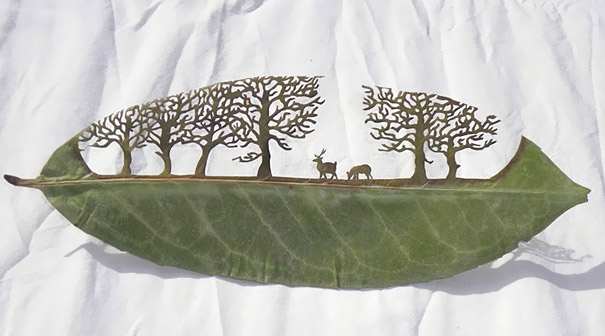
Since I like arts and crafts, I would like to say that this was one of the best IS lessons I ever had. Who knew that by folding the paper differently, it could result in different symmetry effects? Some of the more advanced ones that I have heard of involve paper cutting… on a leaf. Can you imagine?


Paper cutting techniques applied on leaves
 
However, I believe that such a craft (whether done on a leaf or on a sheet of paper) requires extreme patience and care in order to create these beautiful (but delicate) masterpieces.  On the other hand, the finished creation is truly worth all of the painstaking effort that is put in.
In my opinion, this kind of art form is so much better than the modern art of this day and age as the creations made are truly exquisite, unique and timeless.
Good night, fellow readers! I wish you unique and timeless dreams too!
 
Best regards,
Marianne
 
Author’s Note:
References
-          Picture of boy and girl on a leaf retrieved from http://www.weirdasianews.com/wp-content/uploads/2011/08/leaf.jpg


17 September 2012 (Day 12):

I always thought that Beethoven’s famous melodies, such as the 5th and 9th symphony, were impressive. By knowing which piano keys to press, he could create such amazing tunes (even when he turned completely deaf).


However, today I found something equally musical but more amazing. Ladies and gentlemen, may I present… the erhu!


It is a string instrument with only 2 strings. However, when played with a bow and the skill of a professional, it can produce beautiful melodies, though of more oriental taste.

This was the instrument that was shown to us during today’s IS (Interdisciplinary Studies) lesson on Chinese Folk Music. The professional who came to teach the module for today even played some classic songs on the erhu. I’m afraid I don’t know what all the songs were but the only one that I recognized the tune to was “Yue liang dai biao wo de xin” (The moon represents my heart).
 

 The professional playing the erhu


For someone as un-musically inclined as me, I was astounded to see the professional play the songs by ear (whereas I’d probably need a music sheet and about 20 years before I’d be able to play it right). At one point while he was playing another song, he promptly switched to strumming the erhu with his fingers so as to play the more staccato beats (in music lingo, that means short and separate notes).

After his demonstration was over, the professional allowed us to try and play the erhu.

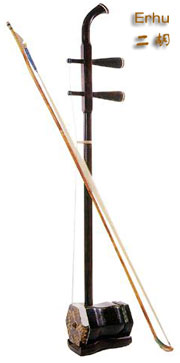
The bow is connected to the erhu as the bow hair is placed in between the inner and outer string of the instrument. Different notes can be played by sliding the bow left and right (on either the inner or outer string) while changing the number and position of your fingers on the strings at the nut.
 

Parts of an erhu
 
 
When we watched the professional play, the bow seemed to glide as smooth as silk across the strings. However, when we tried, it wasn’t smooth at all. There is some friction between the strings and bow hair, and the music we produced didn’t sound like his (at all). Still, it was fun to take pictures with the instruments.

 
Me “playing” an erhu


Our lecturer, Mr Nick Tan, teaching Bernard how to hold the erhu


Vendra trying his hand at the erhu


I hope you, dear reader, will dream of yourself playing your favourite song on the erhu (or piano) tonight!

Happy Dreaming!

Best regards,
Marianne


Author’s note:
 

Picture showing the parts of the erhu retrieved from http://www.squidoo.com/erhu-the-chinese-violin